http://www.albany.edu/offcourse
http://offcourse.org
http://www.albany.edu/offcourse
http://offcourse.org
Loose Leaves from a German Journey, by Ricardo Nirenberg.
Freiburg im Brisgau. The German love of legends. Empty rhetoric. A Francophile town. An Aula with an aura: Martin Heidegger, 1929. Monseigneur Fumaroli. The Anglo-Saxon danger. Gurs.
On the avenue leading from the Freiburg railroad station to the famous university there is a statue, in full Franciscan frock, ropes and all, of the local alchemist and 14th-century monk Berthold Schwarz who (so the story goes) invented gunpowder. It is difficult to imagine on what grounds that disaster has deserved the honors of hard bronze. Then, a little further, there's a sign: GURS 1027 Km. A yellow, squat, pointing pentagon, lettered in black. Although in form it is no different from many other road signs in Europe, yet, you will agree, the information therein is rather surprising: for who has ever heard of a place called Gurs? And where does one find signs showing the road to a point that distant?
Reflecting on those puzzles, I absentmindedly arrived at the main university building, a dull, 1920 or so structure bearing above its front portico the golden-lettered motto: DIE WAHRHEIT WIRD EUCH FREI MACHEN. "The truth shall make you free," which, according to John's Gospel, Jesus said to the Jews, urging them to accept Him as God's anointed one. I went to the end of the building and turned left; there, over the ornate side gate it is written: DEM EWIGER DEUTSCHTUM, "To the eternal Germanness." Now, whatever that may mean, if we assume it means something and that it is true (I mean, that Germanness is eternal), that truth doesn't seem likely to make anyone free, least of all the Jews. But perhaps, when it comes to legends and mottos, it is preposterous and pedantic to expect all sides of a university building to be coherent with one another, just as it would be extravagantly foolish to expect the professors inside to be coherent with one another, or even with themselves. However that may be, I couldn't help putting those incoherencies, together with the ugliness of the building, between brackets, and I had to acknowledge the reality of this elementary phenomenon, that the University of Freiburg appeared to my consciousness surrounded by the sublime, mysterious aura which only philosophy and scholarship can lend.
Life in the U.S.A., forty years of it, cannot possibly be bracketed off even if I wanted to. This huge democracy, where poets and thinkers are considered in no way superior to plumbers or slickers, makes me long for the spiritual elitism, the poetico-pilosophic aristocracy that, perhaps, had I chosen to live in Europe instead, I would have detested. Thus, in Berlin, I stood for a long while under the rain at one of the corners of Kant Street with Uhland Street, just breathing the air, getting wet, and rejoicing at the marvelous conjunction. I know it was a silly thing to do: those who enjoy sociological explanations might attribute such silliness to my having grown up, before moving up North, in a remote, snob-infested, semi-barbaric South-American city which fancied itself part of Europe.
Academic life in the U.S.A., moreover, does not prepare one for the long hours of dreadful flow of empty rhetoric (in German and in French) which inaugurated the conference I attended at the University of Freiburg, and which was the occasion for this, my first visit to Germany. A Federal Minister for Cultural Affairs, the Prorektor of the University, then the Bürgermeister, followed by several diplomats - the French embassy in Berlin, the Swiss embassy in Germany and the Bureau of Québec in Munich all had sent someone with a tedious, solemn speech - followed in turn by the Couselor to the Chancelor on Franco-German cooperation, and by the President of the German Society of French Studies, and I lost count: there would have been a speech by a Hofrat, a Justizrat and a Relegationsrat too, except I think those titles have long since disappeared. The Bürgermeister claimed, this much I understood and remember, that Freiburg is the most Francophile town in all of Germany, which seems to be the case since nobody from other towns lifted a finger to contradict him.
So many paeans were being recited about the cooperation between the two nations separated by the Rhine and by so many ancient rancors, that it became impossible to reflect on the fact that in the not-so-distant past they had fought three wars in eighty years; this being Germany, however, the logorrhea was relieved by some lively pieces for piano four hands played by two young men with Hungarian names. I must hasten to add that, notwithstanding the tedious speeches, as far as I was concerned I would have been happy to sit there all day and all night, for the hall where this ceremony of ours was taking place was the University Aula. Yes, the very same Aula, if with some cosmetic changes on walls and ceiling as I was informed, where, seventy-five years before, Heidegger had delivered his arch-famous inaugural lecture, Was ist Metaphysik? In the brief space of that lecture, the man who has been called the greatest German philosopher since Aristotle addressed precisely the point which was bothering me a short while before, I mean how foolish it would be to expect the professors at a university to be coherent with one another, or even with themselves. Not so, declared Heidegger in this very same Aula in 1929. If we look at it from the metaphysical standpoint, all professors are in perfect agreement with themselves and with one another. For (so Heidegger argued) what is it that all scientists and scholars agree to study? Things that are, and other than those, nothing at all. Now, obviously, nothing at all is the key notion here, and that constitutes the object of metaphysics. The true philosopher ought to be, if you allow me the comparison, like a diver into the boundless waters of Nothingness, in which the other disciplines —math, the natural sciences, history and the sciences of the spirit —are but islands, or rather like atolls, since they, willy-nilly or unconsciously, enclose a lagoon.
However it happened that such a simple, fundamental insight had not been hit upon until then, its importance was soon realized in Germany, and upon translation, in France too; so much so that two generations of French intellectuals, from Sartre to Derrida, were brought up on, and nourished by, it. Except perhaps for Schwarz's gunpowder, soon taken up by the French at Crécy (or was it somewhere else?), it would be hard to come up with a better example of German-French cooperation than this Heideggerian insight, yet not one of the many speakers made the slightest reference to either gunpowder or nothingness. Instead, they kept talking about democracy.
To be fair, I should point out that the title of the conference was "Sprache, Literatur, Demokratie / Langue, Littérature, Démocratie", and certainly one can argue that neither Friar Schwarz nor Martin Heidegger had much to do with democracy.
In spite of all the talk about cooperation, deep disagreements between Germans and French became evident on the subject of the holy trinity of speech, literature and democracy. The Culture Minister said in no uncertain terms that each of those three concepts was impossible to conceive without the other two. Now, this business of declaring some idea inconceivable unless accompanied by some other idea(s) has long been a favorite of philosophers: many have affirmed that color, for example, cannot be thought without extension, and Ortega y Gasset wrote somewhere that a spherical surface cannot be thought without the solid ball inside. When I am really, madly angry, however, I see red without experiencing any spatial idea: I simply see red. And any competent mathematician will testify that it is perfectly possible to imagine an n-dimensional sphere without any reference to the n+1-dimensional ball bounded by it. But the imagination of philosophers, like that of politicians, tends to be irretrievably bound by their particular agenda. So I will always be skeptical about statements such as the one by his Excellency the Culture Minister; yet I wasn't quite prepared for what followed, I mean for the astounding counterstatement from the keynote speaker, Prof. Dr. Dr. h. c. mult. Marc Fumaroli, de l'Académie française, professeur au Collège de France.
Before we plunge into the astounding counterstatement, though, it may not be a waste of time to say a few words about Monsieur Fumaroli himself. I had read some of his stuff, and vaguely remembered his splenetic defense of the French language against the threat of international American English, which, to his mind, is purely instrumental and does not demand any engagement on the part of its speakers. I'm only quoting and am not sure what "engagement" may mean here precisely; perhaps it has something to do with the mystic frisson that, as I have heard a French poet claim, is elicited by French words such as terre and ronce, earthy words containing a rolled r. Perhaps Fumaroli dislikes American English because it lacks that special sound. Whatever the reason, his dislike is stark. Having never met him nor seen his photograph, I recognized the academician as soon as I saw him on the Freiburg streets leading from our hotel to the university. For who else could that white-haired gentleman be, impeccably dressed and groomed, walking straight and nobly, holding his hands behind his back, followed by lictors and flanked by obsequious lesser lights? An ancient Roman senator redivivus, or a Renaissance Roman cardinal at the height of prestige.
When his turn came after the pianists finished playing Georges Bizet's Jeux d'enfant, Monseigneur Fumaroli took to the lectern and said he was quite surprised to have heard Bizet instead of Richard Wagner in Germany: Bizet whom Nietzsche, toward the end of his life, preferred to Wagner... Then, getting serious and brandishing Tocqueville, he proceeded to declare democracy all but incompatible with literature. What better proof than America? America where only money speaks, America who had not recognized Poe's genius as the French did. At this point I thought I saw Fumaroli enveloped in smoke and heard him hawking roasted chestnuts. I feared he was going to declare, like Baudelaire, his debt to Joseph de Maistre. But no: instead, he proclaimed himself a disciple of Leo Strauss, thank God. And thank God, too, no one seemed to notice the strong disagreement between the French academician and the German minister.
About the old contention between arms and letters which occupied Renaissance wits, we moderns placidly agree that none of those two had pride of place or was a help or hindrance to the other; but when it comes to the present pair, namely democracy and letters, how could Fumaroli and the German minister agree? The former dreams of "le grand siècle" of Louis XIV, the other has the Nazi years never far from mind. Where the Frenchman concluded very Frenchly that "la littérature naît toujours d'un désaccord avec le conformisme du régime en vigueur" [litterature is always born as a reaction against the conformism of the ruling system], how could a German mouth the like without sounding an awful Nazi or Stalinist chord? This historical difference between the two nations came up again a little later, at the session where I had been invited to speak, when, at the end of his talk, a French poet was taken to task by two young German scholars. The poet had lamented the situation of his Acadian confrères, writing in French but surrounded and threatened by Canadian English. German scholar number one burst out, "You French, you're tiresome, always carrying on about your Francophonia!" And German scholar number two: "Identity politics again! All that belongs to the past!" Finally, German scholar number one asked, "What has such nonsense got to do with good literature?"
You can easily put yourself in the German scholars' shoes: suppose your right leg has just been amputated, and someone comes to you complaining about a corn in his toe. And you can as easily see why "identity politics" doesn't hold much charm for young Germans who, unlike most French, do not feel that keenly about their national identity, nor about the need to protect it against hegemonic Americanism. Moreover, the poor German scholars had probably built up a head of steam, sitting mum while Monseigneur Fumaroli sermonized for well over an hour on the perils American democracy and American English pose for literature, just as, about a century ago, he would have sermonized on the dangers of ragtime. Before I forget, let me give the French academic his due: toward the end of his lecture he did propose a remedy, namely, universal instruction in the classical languages, Greek and Latin.
Out in the street again after the keynote speech, I remembered Plutarch's advice, that just as, upon rising to leave the barber's shop, we inspect our head on the mirror to see if the barbering job is well done, after a lecture we ought to examine our mind, whether it has shed any encumbrance and superfluity, and has become lighter and more cheerful. Well, about Monseigneur Fumaroli's lecture I wasn't certain. When I arrived at the road sign I have already mentioned - Gurs 1027 Km - I interrupted the examination of my mind because I noticed a plaque I hadn't noticed before. On the plaque it was written that on October 22nd of 1940, 350 Jews from Freiburg were deported to Gurs, where 273 perished. This explained the unusual sign, pointing to a place so unrealistically distant: it was meant as a memory, perhaps as a symbol of repentance. But where was Gurs? And why there?
A friend of mine, Eric Freedman, a specialist in the history of the Vichy regime who was also a speaker at the conference, informed me that Gurs is a small village in France, in the department of Pyrénées-Atlantiques, where the administration of Maréchal Pétain maintained a concentration camp — originally built in 1939 by the French Republic to hold the refugees from the Spanish Civil War — and that all those Freiburg Jews died there perhaps because no provision whatever was taken for the lodging and feeding of so many people (a total of 6,538 Jews were sent there, on the same day, from several regions of Germany). 350 people is a crowd hard to miss in a town the size of Freiburg: what did Heidegger think, or say, he who had just taught a course on Nietzsche and European nihilism, when, on his way to or from the university, he saw, or heard, or heard of, those rounded-up unfortunates? And October 22nd 1940: that is surprisingly early in the history both of the Vichy regime and of the German effort to exterminate all Jews. Why there, in Gurs? One may say, perhaps, that it was a pioneering venture, a prominent modern example of Franco-German cooperation.
And so I stood before the road sign pointing to remote Gurs, and was reminded of that song, one of the most poignant of Schubert's Winterreise: "Habe ja doch nichts begangen, daß ich Menschen sollte scheu'n... Einen Weiser seh' ich stehen unverrückt vor meinem Blick; eine Straße muß ich gehen, die noch keiner ging zurück" — I have committed no crime, that I should thus shun mankind... I see a road sign standing there, firmly before my eyes; I must travel a road on which no one has ever traveled back.

Tübingen. The Black Forest. The Hotel Am Schloß. The Neckar and the Hölderlin Tower. The Tübingen Stift and the Triumvirate of the German Spirit. Monseigneur Fumaroli again.
On the train to Tübingen, an unpleasantly corpulent German lady sat facing me and, having placed her belongings in several places nearby, immediately opened a cross-word- puzzle magazine and started filling the little squares. Her forearms were as thick as my thighs, but more freckled; she filled the little squares speedily and assuredly and so I admired her, especially since it was a German crossword puzzle, as I could see. What a devilishly odd language, where the sun is of the feminine gender! And yet, I had to admit, there might be something to it, for out there the sun was hiding behind a delicate and complicated array of mist and clouds, now peeping brightly out, now hiding again, just like some Fatima or Zobeide doing the dance of the seven veils before the entranced caliph — and could you imagine anything more feminine than that? When the sun managed, or consented, to shine through, one could see the dense and dusky trees, firs for the most part, extending far away, and elongated masses of steam rising out of their tops, like gigantic love sighs.
Ah, the German language! What Woman or the Eternal Feminine was for some men like Goethe, namely the personification of mystery, of depths of meaning no one can hope to fathom or dredge up, that is for me the German language, and it has been so ever since I first took it in the Buenos Aires high school with Herr Probst, an old, boring, babbling, and, generally speaking, terrible teacher. Take, for example, the well known line of poetry: "Mir träumte einst von wildem Liebesglühn": quite apart from the power, so often acknowledged, of German compound words — "Liebesglühn" looks so much more specific and precise than "Love glow," although philistines will insist that they are equivalent — quite apart from that, what makes my head spin is the impersonal way of saying that I dreamed. "Mir träumte": it is not I or my brain who is the efficient cause of my dream, it is rather a vague outer agency - Es or It, the gods — who make the dream and give it to me as a gift. Yes, yes! The ancient gods still roam around, if not on the earth, then at least inside the German language.
It was getting late and I suddenly felt terribly tired, so I lay down on the ground, on the edge of a clearing where the trees had been felled not long ago, to judge from the fresh look of the stumps. After a while of looking up at the clouds in the sky, I felt hungry too, and I thought I better look a bit more down to earth for something to appease my stomach with. Over the trees on the opposite of the clearing I saw smoke going straight up as from a chimney; I walked up to the place and found myself before the hut of a charcoal burner. I knocked on the door, and the charcoal burner himself came out and kindly invited me in to partake of his dinner. He was a small man, with a small moustache and a funny little felt cap on his head, graced by a funny little feather, but his hut contained a lot of firewood arranged in piles against the walls; there was a window, and near it, a wooden table and benches, on one of which I sat, at his bidding. I noticed a bookshelf containing nothing but the complete works of Friedrich Hölderlin, the Stuttgarter Ausgabe I believe, and I had already plunged myself into the reading of a table of contents therein when a woman servant, whom I hadn't noticed before, interrupted me in order to set the table.
She came and went back and forth, carrying plates, napkins and so on, and I had plenty of leisure to observe that she had, on top of a massive and ungainly fiftyish frame, the ugliest Teutonic face and the most brutal, butcherly expression one can imagine. Having completed the setting of the table, she was turning to leave when I, in a sudden burst of sure inspiration, pinched her behemoth behind. Just as on a TV screen the image is immediately changed at the push of a button, just so the ugly woman servant was now changed into a young, extremely attractive maid, splendidly dressed. There were even jewels on her neck and shiny silver brooches at the ends of her long, blond braids. But before she could express her gratitude, before she could give me a kiss with those adorable lips of hers, the little man, the charcoal burner, fell upon me, angrily screaming, "What have you done, you miserable man! Now old Gudrun will be leaving my service, and not only will I have to clean and wash and cook for myself, goddamm it, but I will be obliged to pay her dowry, no doubt! Out with you! You have been my ruin, now get out of my hut!"
I was so shaken by the little man's outburst that I awoke to discover that I was still on the train, that out of the window one could still see the closely packed firs of the Black Forest, and that facing me, the corpulent German lady was still sitting and her gigantic forearms were still gigantic and still freckled. She was having her lunch: in one hand she held several slices of dark bread, and in the other a sausage of no mean diameter, which she was eating the way we Americans normally eat a banana.
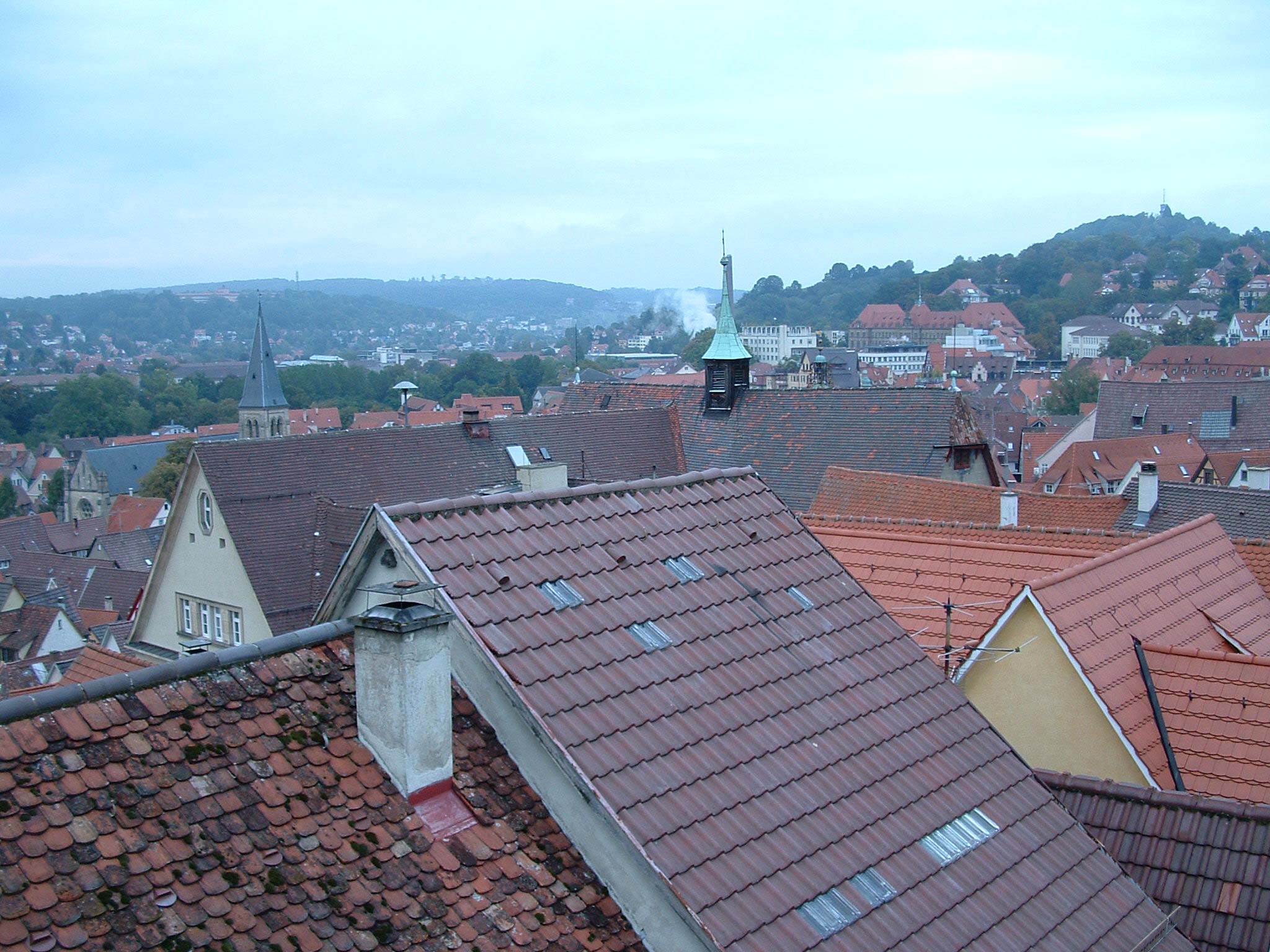
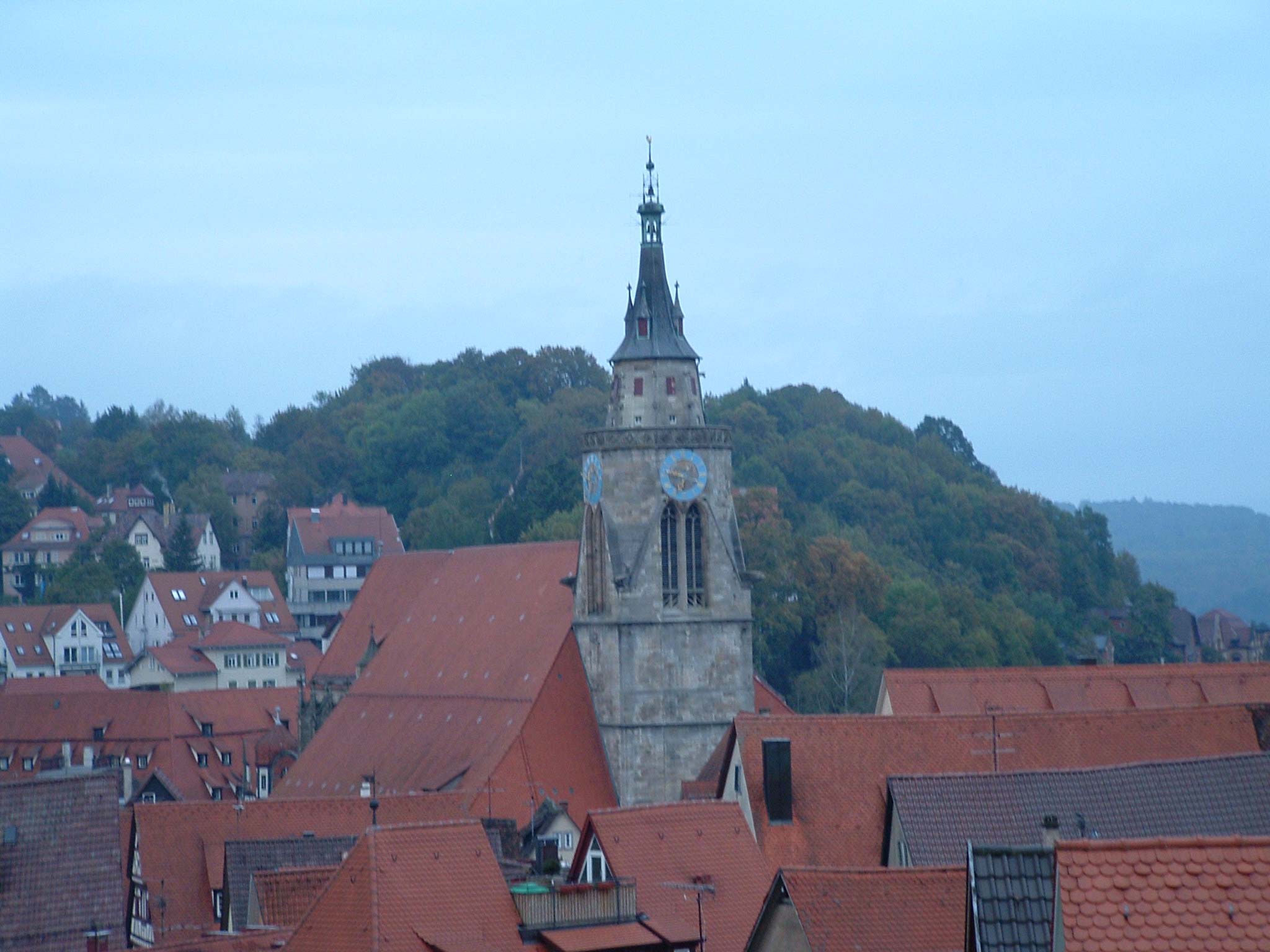
Tübingen, as one can read in the green Michelin, was spared the destruction rained some sixty years ago on most German towns, and the picturesque medieval buildings are still standing. At the train station I hired a cab to climb the narrow streets leading to the castle up high; next to it is the hotel Am Schloß, which I recommend, especially the room in the attic, a very old room with modern sky windows which, when open, let inside, every half hour, the unsynchronized yet timeless sound of bells from three different churches nearby. The food there is pretty good too, even though the menu seems to be written in Sumerian. Upon asking, I found out that it was only the names of the local Swabian dishes in the local, Swabian dialect. From my room windows I had a magnificent view of the town from above: looking at all those red-tiled roofs, a pretty image occurred to me which must have occurred to thousands before, namely that it all looks like a big bunch of red roses with greenery all around, something probably arranged in some flower shop in upstate New York, where most florists are of German origin.
I found out from the host how to go down to the Hölderlin tower. I had that most in mind as a purpose for my visit to Tübingen, even though no doubt the University and its Library are well worth a visit, and even though there were several scientific conferences taking place there and then well worth listening to. But, with conferences as with haircuts, one every month or two should be enough. As for the castle right next to the hotel, it houses several university institutes and a museum, wherein some interesting paleolithic remains are kept: the museum I resolved to visit at a later time. I descended therefore to the Hölderlinturm, on the left bank of the Neckar. Both the tower and the river are more beautiful than I had imagined. I mean beautiful in Plato's sense, that is to say, contemplating river and tower I suddenly recognized the essence of something I had long been acquainted with without properly knowing it: German Romanticism. The place seems to be the one all German Romantics had in mind whenever they yearned in writing or in song for a place to rest, which was often enough. There the water runs without a murmur, the boaters don't ply oars nor paddles, but a punting-pole, and that without a splash; the low-hanging branches of the trees don't rustle unless they really have to, and even the dogs don't bark. As for the tower, it is yellow. The Germans seem to be very fond of a certain tone of yellow for their buildings: at the Fuggerei in Augsburg, my friend Till Kuhnle, who lives in that town, informed me that the almshouse was painted in what he called "a kind of Habsburg-yellow", but I must say I saw yellow-painted palaces in Berlin, a yellow which must be dubbed, I suppose, Hohenzollern, and I'm willing to bet there are still other buildings in Germany painted a pretty Hohenstaufen-yellow. To me all those yellows look the same, but in truth I am not good at either colors or genealogy.
When it got dark, I returned to the hotel, and I had a chance to inspect again and try to decipher the idiosyncratic menu, until the kind waiter took it away and gave me another for English-speaking guests. Some words are untranslatable though, as every translator knows, and one of those seems to be the word "Spätzle", which appeared all over both menus. After some mental effort, I reached the tentative conclusion that it had to be a diminutive plural of "Spatz", sparrow. That Swabian diminutive ending, you see, seemed to me much like the Yiddish diminutive ending which is one of the earliest things I learned in life, because my Yiddish-and-Spanish-speaking grandmother used to call me "Rikushkele", that is to say "little Ricardo," surely influenced and thus deformed by the Spanish adjective "rico", cute. All right, but does one eat sparrows, no matter how small or how cute they are? No, the waiter told me after a hearty laugh, Spätzle are the local noodles, known and eaten all over Germany. After that, of course I had to order something with lots of Spätzle. As I was waiting for it, I consulted the 24th edition of Kluge's Etymologisches Wörterbuch der deutschen Sprache, which I had just acquired and which, by almost unparalleled good fortune, lay unopened on the chair next to me. There, in Kluge, I learned that according to the latest research (apparently as recent as 1992), "Spätzle" (Swabian noodles) and "Spatz" (sparrow) are unrelated words.
I would have slept like a tired dog, except that about every half hour I was awakened by the sound of church bells, and during my intervals of sleep I would dream that I was back in the Middle Ages. The following morning, after a typical German breakfast consisting of an assortment of breads, sausages, cold cuts, cheeses, eggs, jams and juices, plus coffee of course, I went out and wended the same way toward the Hölderlin tower. This time, shortly before arriving there, at the bottom of a stairway I noticed the sign at the gate of a building — Stift Pforde — and I slapped my thighs then my brow: this, yes indeed! this was the famous Tübingen Stift, or school for evangelical pastors, which Hölderlin attended all through the fervorous, revolutionary years 1788-1793, and where he studied theology and philosophy, and perhaps other subjects as well.
With an emotion that's easy to understand and a veneration that should only be surprising if it were lacking, I touched the stone gate. How often, I thought, must Hölderlin have come to this place to smoke his pipe, since smoking was forbidden at the Stift! I could picture him, shivering from the cold, his beautiful, long, blond hair gray from the snow, while he, between puff and puff, under his breath, cursed the Super Attendenten, the Procurator, the Ephorus, and the whole tyrannical lot. But look how times have changed, and how widely liberty has spread its wings! Today Germans smoke where and when they please. I walked into the Stift yard and looked around. Which could have been the room where Hölderlin, Hegel and Schelling lived together? Its windows faced East, that I had read somewhere, but it was useless knowledge since I didn't have a compass with me. Wherever it was, that sacred room had witnessed the birth of the ideas over which we have been mulling for these last two centuries, the ideas that have made us so self-conscious about our own unhappiness and such experts in cataclysms.
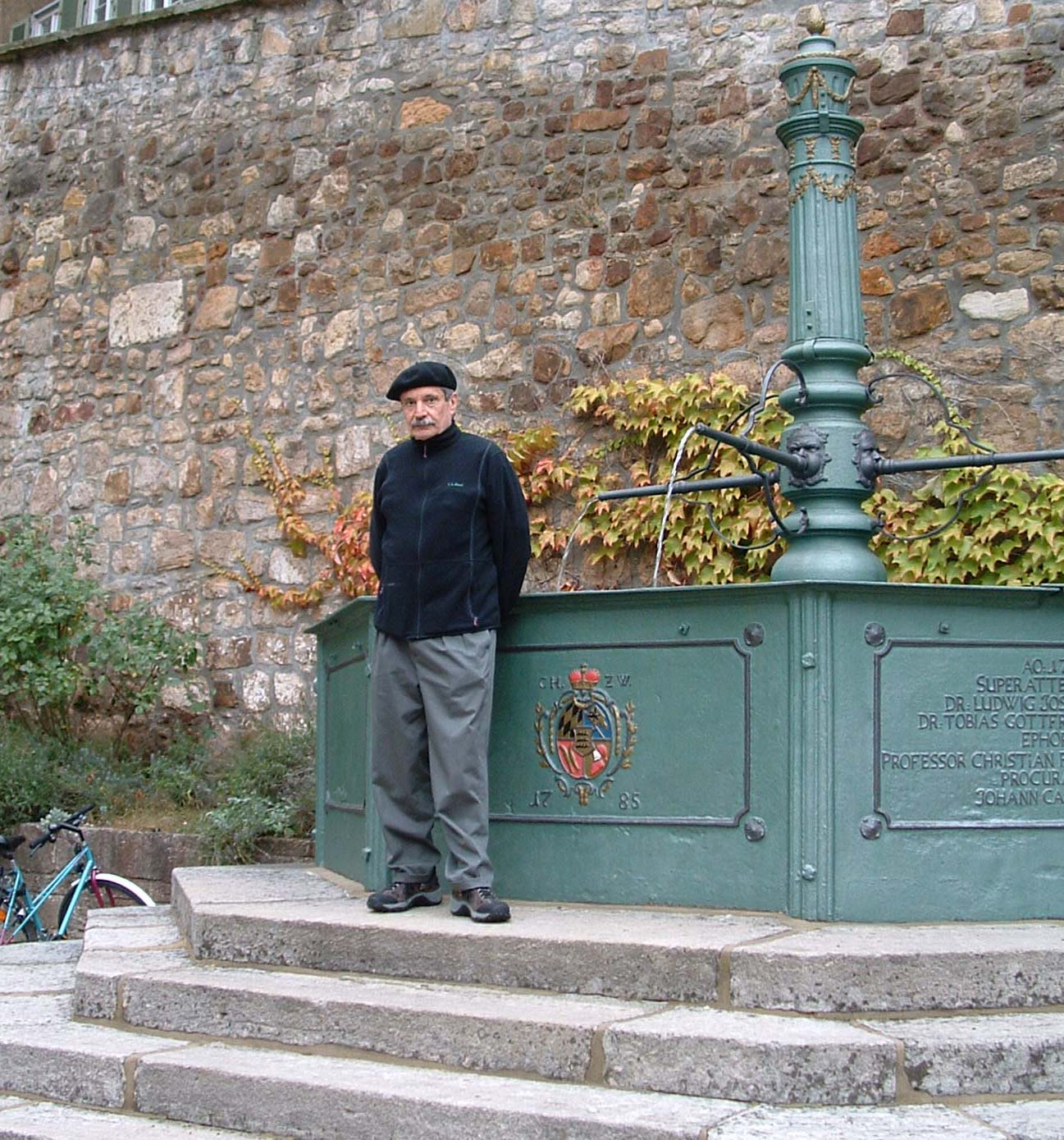
Three students, three friends whose ambition was noble and immense, they all graduated from the Stift, but none of them became a pastor, unless we take that word at a still higher metaphorical level. I thought of the two ancient Roman triumvirates, and of their aping in early-19th-century Argentina: "Primer y Segundo Triunvirato" was the abstruse kind of subject I had to study at school as a child, harder going by far, even at that age, than reading Hölderlin, Hegel or Schelling. No: as far as I know, the only story of three youthful friends remotely comparable in interest to the story of Hölderlin, Hegel and Schelling in Tübingen, is the Persian poet Omar Khayyam's and his two friends, the one who became vizier and the other who became founder and chief of the Assassins. But to return to the things themselves: on one side of the Stift yard there is a fairly large, octagonal fountain; water is poured from three long spouts. Ordinarily I am not into number symbolism, but the significance of those spouts being precisely three is too important to be passed over, and that not merely because we are talking about three friends, nor because three happens to be such an important ingredient of the Nicean creed.
No: the fact is, the number 3 plays a fundamental role in the ideas we are still mulling over, and this must be because it played an equally fundamental role in the youthful lives of those three Tübinger friends. To begin with, liberty, the name and the thought of cosmos-creating freedom were constantly on their lips, in their hearts and in their minds: it was quite a scandal in their day, when they erected a tree of liberty somewhere around the Stift, perhaps in the same place where I was standing then, and joyously danced around it. Liberty: one cannot emphasize too strongly that the dear concept involved not only the right to kick out tyrants petty and gross, including the hated duke Karl Eugen of Württemberg, but, above all, the ability and power of man, the freedom, keenly felt then for the first time in history, to shape destiny and the whole universe to his spirit.
But there was something else in the hearts of those three friends, held as deeply, and that something else was hard to square with freedom and liberty. Simplicity, innocence, a state of nature, that is to say, a life in total agreement with nature, was their other ideal: the simplicity and innocence of childhood, the humble, local origins, enshrined in certain human faces, tones of voice, domestic objects, of the spirit whose ambition would later know no limits. The heart and the mind were unbearably split. On one side of the split, if what one yearns for is the simplicity of the linden-tree by the well, what use is freedom, and why not spend one's entire life close to the linden-tree and the well, from cradle to grave, puffing away at one's pipe during some of the time in between? On the other side, for a mind occupied with sublime, universal thoughts — whether they concern the differential equations describing the motions of the stars, or the metaphysical question of how human-made symbols could go so far as to make sense of God's creation — what business has such a mind with the insignificant minutiae of a particular linden-tree near a particular well, or even with the particular lap of a woman who just happens to be one's mother?
Two sides of the spirit in strenuous opposition, that is tragic, but it has been — ah, how often! — accepted "philosophically" by saying or sighing, "Such is life," or, "Such is Man," or, "What are you gonna do about it?" The three friends, however, would have none of that kind of philosophy, and in this I think they were inspired by the three long spouts of the octagonal fountain at the Stift. There must be, they became convinced, a third moment, a conciliation, a synthesis, that is to say, a return of the heroic, free, cosmic-ranging spirit, in possession of all the treasures of the cosmos, to the simplicity of childhood and the house — to the very same simplicity of the origin, yet infinitely richer. And so, you see, from those long spouts eventually sprouted the dialectics that were to play such a prominent role in the history of the 19th and 20th centuries. I made a hollow with my hands and caught in it some water from each of the three spouts; then I let the water spill on the ground, a libation for the untold, unquiet shades of those who, all over the world, have suffered from the dialectics.
As I was leaving the historical premises and started walking down to the Neckar, it occurred to me that perhaps I had been exaggerating, both regarding the importance of the three spouts and the originality of the dialectical germ in the minds of the three friends. For a tune came, sudden and unprompted, to my mind, a melody that is simplicity itself, and that I immediately recognized as the aria at the beginning of Johann Sebastian Bach's Goldberg Variations. After which, as nowadays all educated people know, but perhaps the three Tübingen friends did not, after which come thirty variations, with the same harmonic structure as the aria, and those thirty variations are like a fantastic voyage through the cosmos, until the last one comes, Quodlibet or anything-goes, except that it is never that, never absolute anything-goes, but rather the freest imaginable imagination, yet subject to strict harmonic rules. And then, at the end, the same aria, da capo: one must accept that it is the same tune, note by note, yet it appears — it is — infinitely richer than before. And so the third spout, the final synthesis, the return home, appears here already in all its glory, fully fifty years before the time when the three friends were confabulating at the Stift.
Just like metaphysics, the science of aesthetics abounds in meaningless questions. Some of the most egregious bear on the possible relations between art and life: Does, or should, or could art imitate life? Does, or could, or should life imitate art? Should, or could, or does a chest of drawers imitate a mollusk? Such meaningless questions commingled in my head with Bach's little tune, now that I was again standing before the Hölderlintürm. The young poet left the simplicity of the Tübingen Stift, his two friends, his mother and his nearby home and, just like Bach's aria, went into a cosmic grand tour. That was, I think, in 1793. Ten years later the poet was back home for good. From then until his death — for a biblical forty years! — he lived here, incurably mad, in a room up in this tower which belonged to a carpenter named Zimmer, but a stone throw from his old room at the Stift. Sometimes he would write, impromptu, a short poem for a visitor and sign himself Scardanelli, although I think that both Schelling and Hegel were ever too busy thinking, always too involved in their own bitter rivalry, to ever come back and visit their old friend. I once heard it said by a brilliant disciple of Lacan, that Hölderlin went mad because he realized it was the only possible way to escape the dialectic.
However that may be, in life at least, synthesis comes in very different flavors. Yes, that much is clear, and so it was with some degree of satisfaction, having like Descartes settled on just a single, distinctly clear thing, that I walked a bit along the Neckar, climbed up some winding stairs and in no time found myself facing the Rathaus, going around a statue of Neptune in a square called Am Markt. Neptune? Hm. Why should the ancient god of the sea stand here in Tübingen, so far away from his realm? The trident he holds in his hand doesn't prove much, and "Neptun" might be a local euphemism for "Teufel", the devil, who happens to be everywhere.
Alas, that proved to be only too true. For it so happened that I noticed a corner café and went there in search of refreshment. They had not only coffee, but also an assortment of cookies and cakes, and, best of all, free use of their Internet computer. I took advantage of the latter to read my e-mail, something I had not done in quite a while. As usual, there was a lot of junk, which I had to clear out before I got to the only genuine message, which was from a literary agent in New York I had sent a manuscript to. In it, she informed me that although my novel was excellent from a literary point of view, she couldn't see how she could sell it to any of the trade houses, and that therefore, she was sorry to decline.
While I sat dejectedly on a low wall, either at the Am Markt or elsewhere, my thoughts flew back to Freiburg. Ah, Monsieur Fumaroli, how wrong I was to have made fun of your rhetorical laurels and academic costume and épée, fun of your Anglo-Saxon menace and of your proposed redemption through the Editions Budé! Now I mournfully confess that you were right. But ah, mon cher maître, how I wish you hadn't been! Yes, just as you said, America is at perpetual war against the Republic of Letters, a war where money and stupidity are the weapons of choice. After a while of sitting there, it was hard for me to say if I was sadder because of the agent's rejection of my manuscript or because I was forced to acknowledge what was undoubtedly true in the French academic's keynote speech.
The next day I took the train to Göttingen, curious to taste the famous sausages and to visit the famous university.